
JONA - A Modular AI Agent System
PROJECT INFO
Year
2025
Scope
Product Strategy
UX Architecture
UI/ Interaction Design
Demo prototype
Role
Senior Product Designer
VIEW DEMO VIDEO
A short walkthrough of how JONA works in practice.
INTRODUCTION
JONA explores a different direction for AI agent products—focusing on pre-built roles, modular capabilities, and visible intelligence growth.
AI agents should feel like workers you equip — not tools you constantly configure.
Instead of asking users to build complex workflows or prompt chains, JONA lets them:
- Start with pre-built, job-based agents
- Enhance agents over time with knowledge and automations
- Observe how the agent’s behavior evolves through use
This project explores how AI products can feel more opinionated, progressive, and human, while still being powerful.

THE PROBLEM
Existing AI tools force users into the wrong mental models
Today’s AI products generally push users into one of two mental models — both flawed for everyday knowledge work.
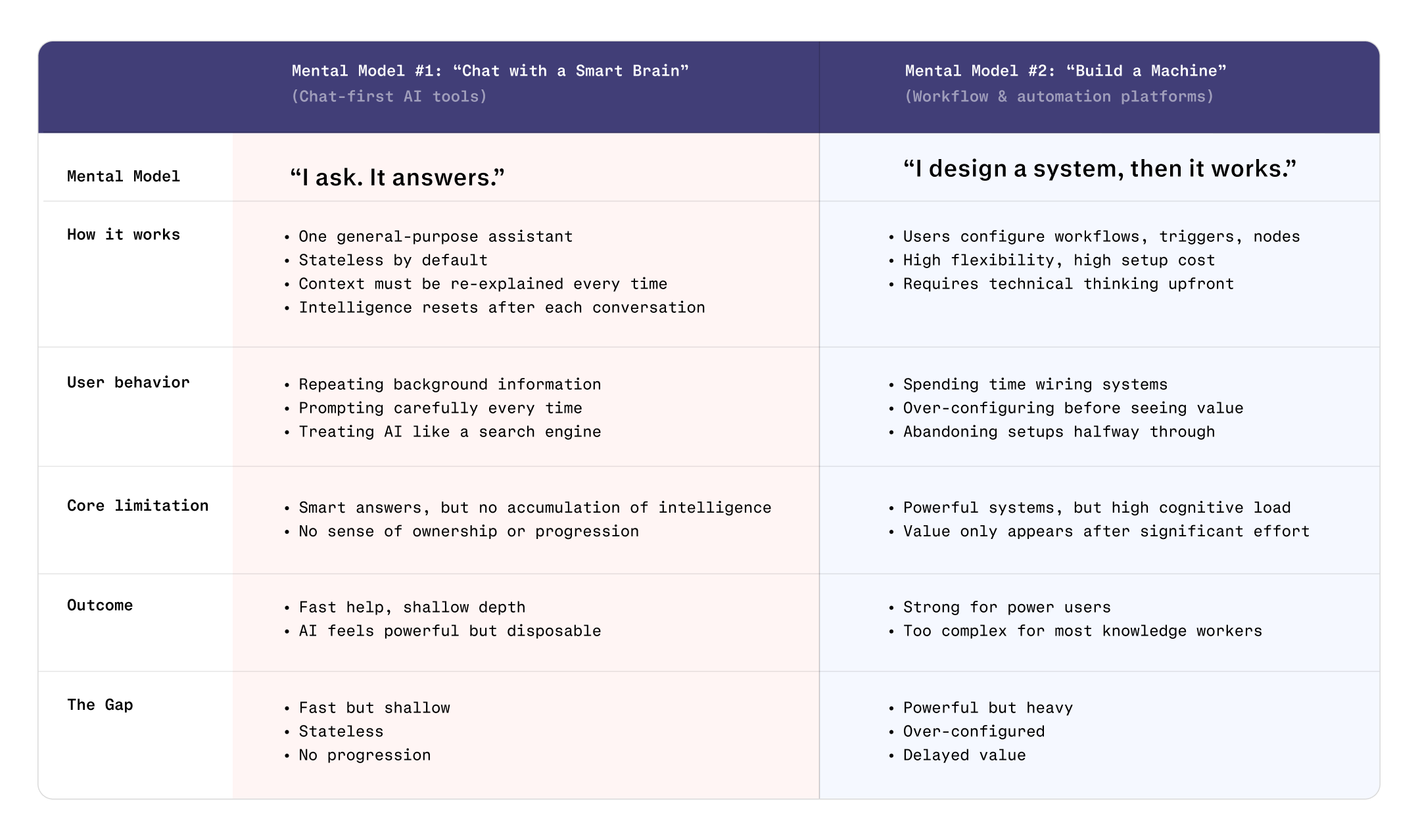
What's missing
A mental model where AI can start simple, then grow smarter over time — without forcing users to think like engineers.
THE OPPORTUNITY
Reframe AI not as:
A brain you talk to or a machine you build
…but as: A worker you equip and grow.
This insight became the foundation of JONA.
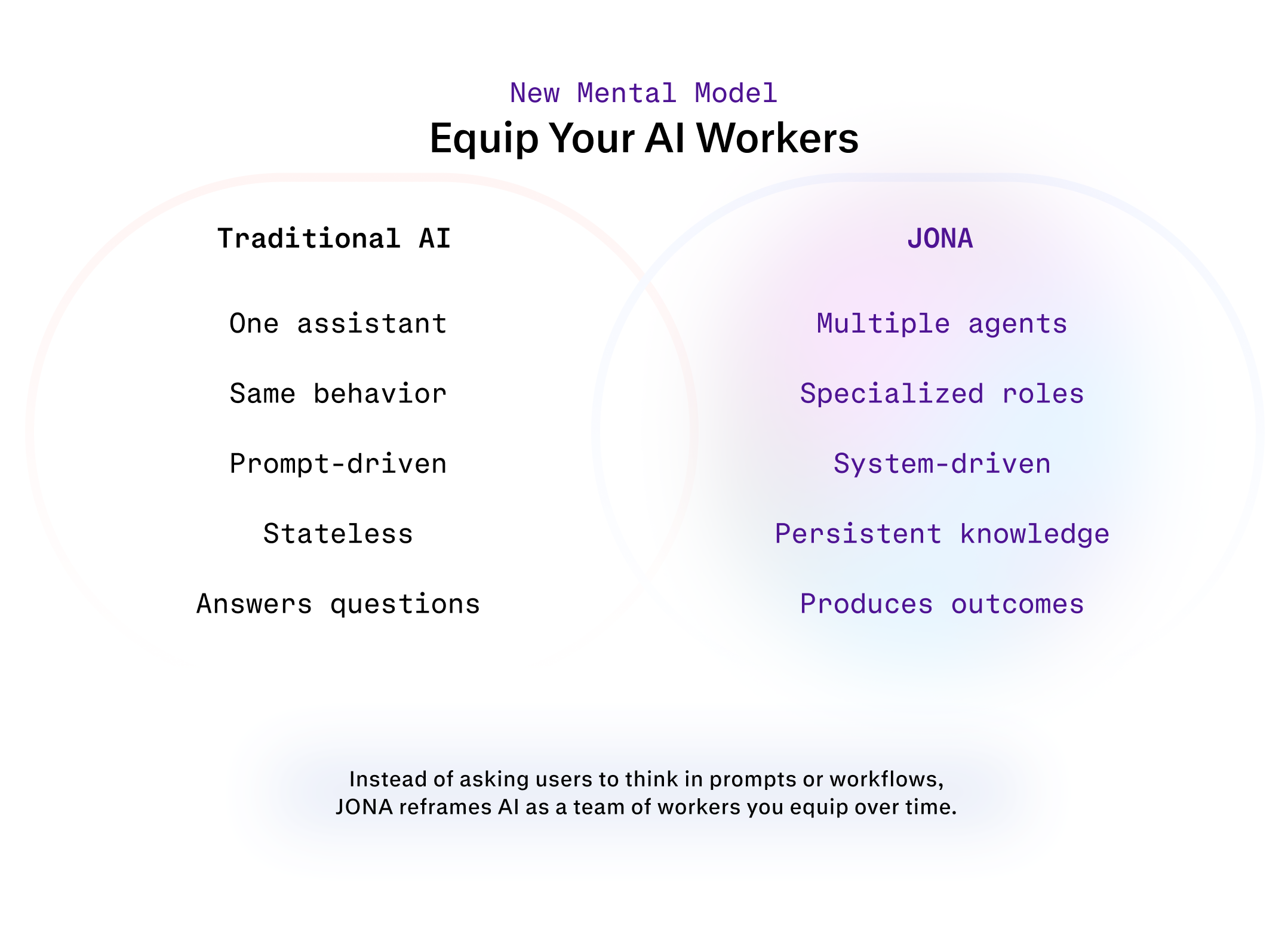
In JONA:
- Agents start useful by default
- Knowledge deepens their thinking
- Automations extend their autonomy
- Intelligence becomes visible and cumulative
PRODUCT PRINCIPLE
1. OPINIONATED OVER FLEXIBLE
Users don’t want infinite options — they want good defaults.
2. PROGRESSIVE COMPLEXITY
No heavy setup upfront. Power is unlocked gradually
3. VISIBLE INTELLIGENCE
Users should see how an agent improves, not just trust it.
4. SYSTEMS, NOT SCREENS
Every feature must fit into a coherent ecosystem.
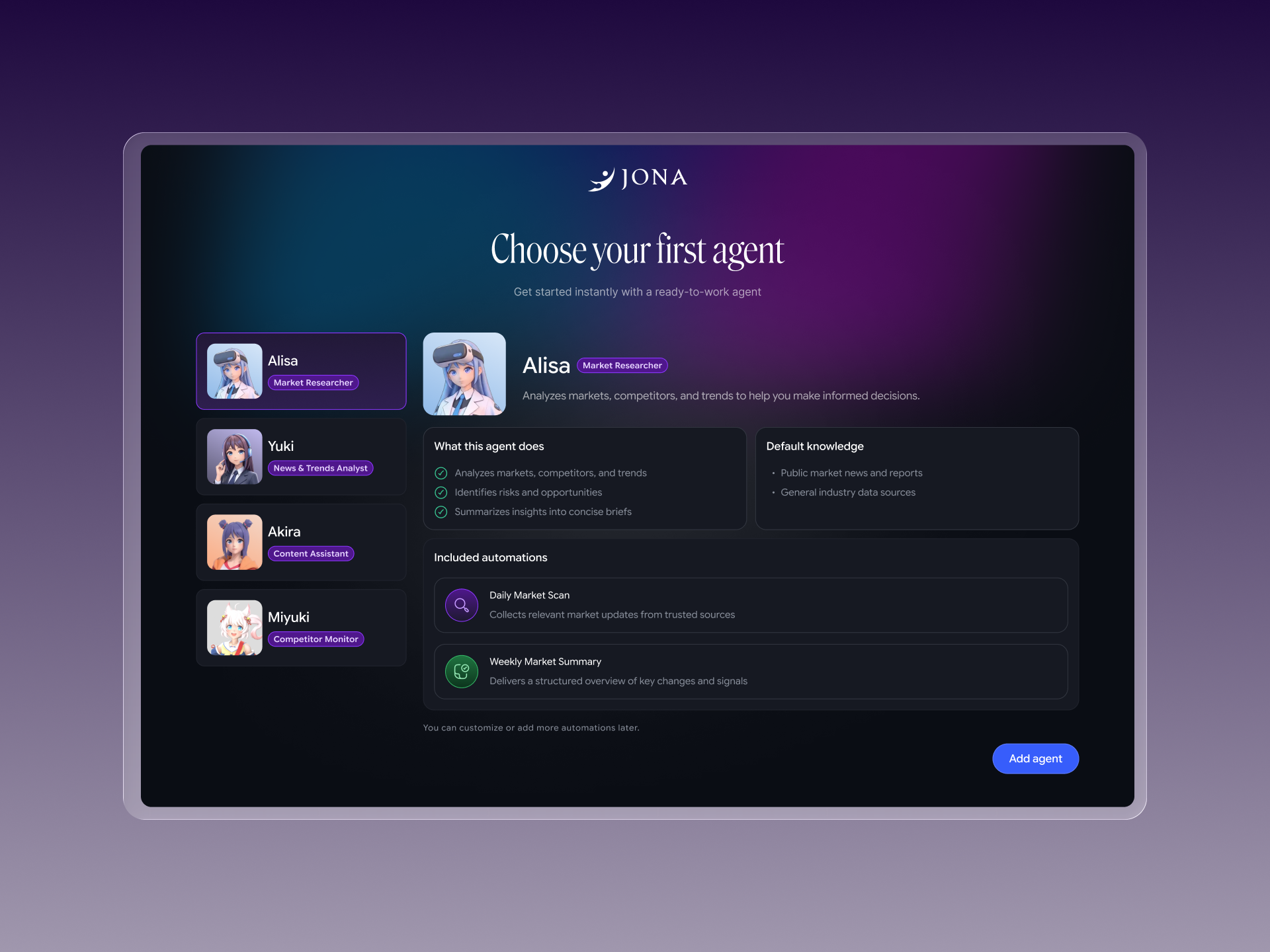
Onboarding: Choose Your First Agent
Instead of asking users to create an agent from scratch, JONA starts with job-based agents, such as:
Market Researcher, News & Trends Analyst
Competitor Monitor, Content Assistant
Each agent clearly communicates:
-What it does
-What it’s good at
-What automations are included by default
This ensures users experience value within minutes.
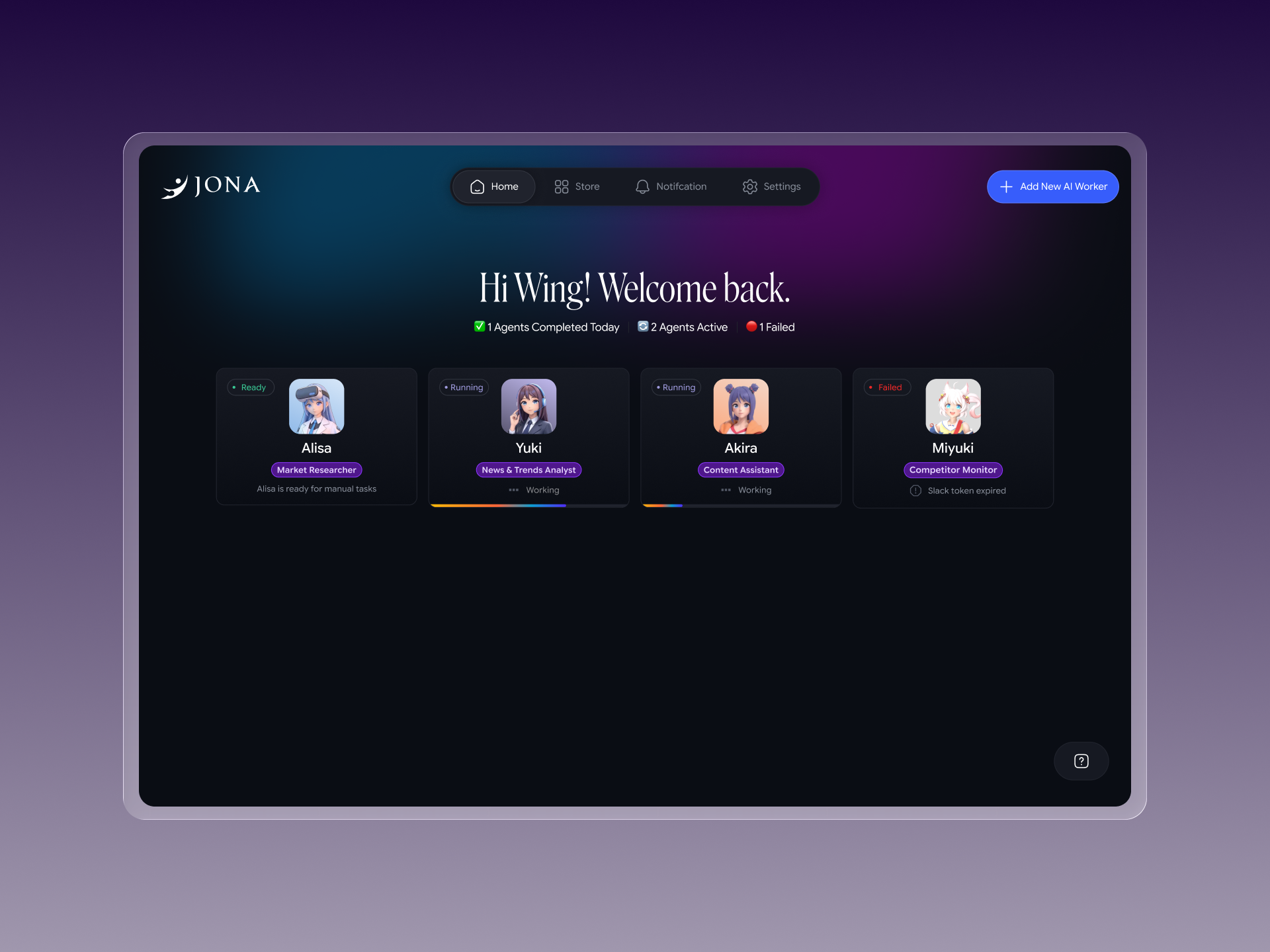
Agent Experience
Once added, an agent lives as an independent worker:
Status: Active / Running / Failed
Activity history
Files generated
Installed knowledge
Installed automations
Users can:
Chat with the agent
Rename it
Equip it differently from other agents of the same type
The Store: Equip Your Agents
The Store is divided into two clear categories:
KNOWLEDGE
Static intelligence that improves reasoning quality:
Market reports
Industry insights
Domain-specific context
AUTOMATION
Recurring workflows the agent can execute autonomously:
Daily briefs
Weekly summaries
Monitoring tasks
This separation keeps the mental model clean:
- Knowledge = how the agent thinks
- Automation = what the agent does repeatedly
Knowledge Detail Page: Making Intelligence Visible
A key challenge was helping users understand why installing knowledge matters.
THE SOLUTION: BEFORE & AFTER PREVIEW
For each knowledge item, users can:
Select a sample question
Compare a default agent answer
See the equipped agent’s structured, deeper response
This removes abstraction and builds trust instantly.
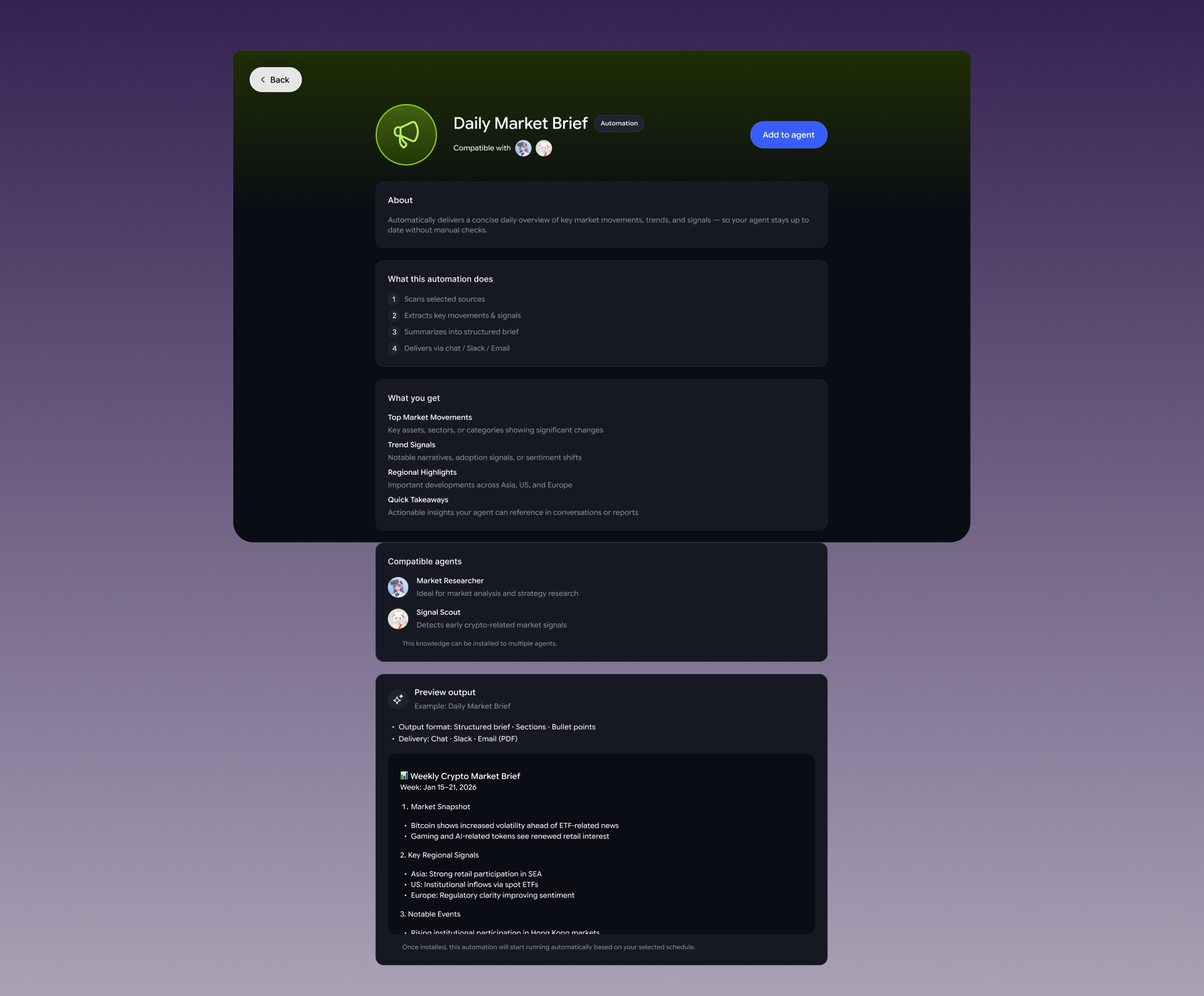
Automation Detail Page
Each automation clearly communicates:
- What it does
- How it works (step-by-step)
- What output looks like
- Where results are delivered (chat, Slack, email)
Preview outputs are shown as realistic, structured reports — not placeholders — reinforcing perceived value.
Visual & Brand Direction
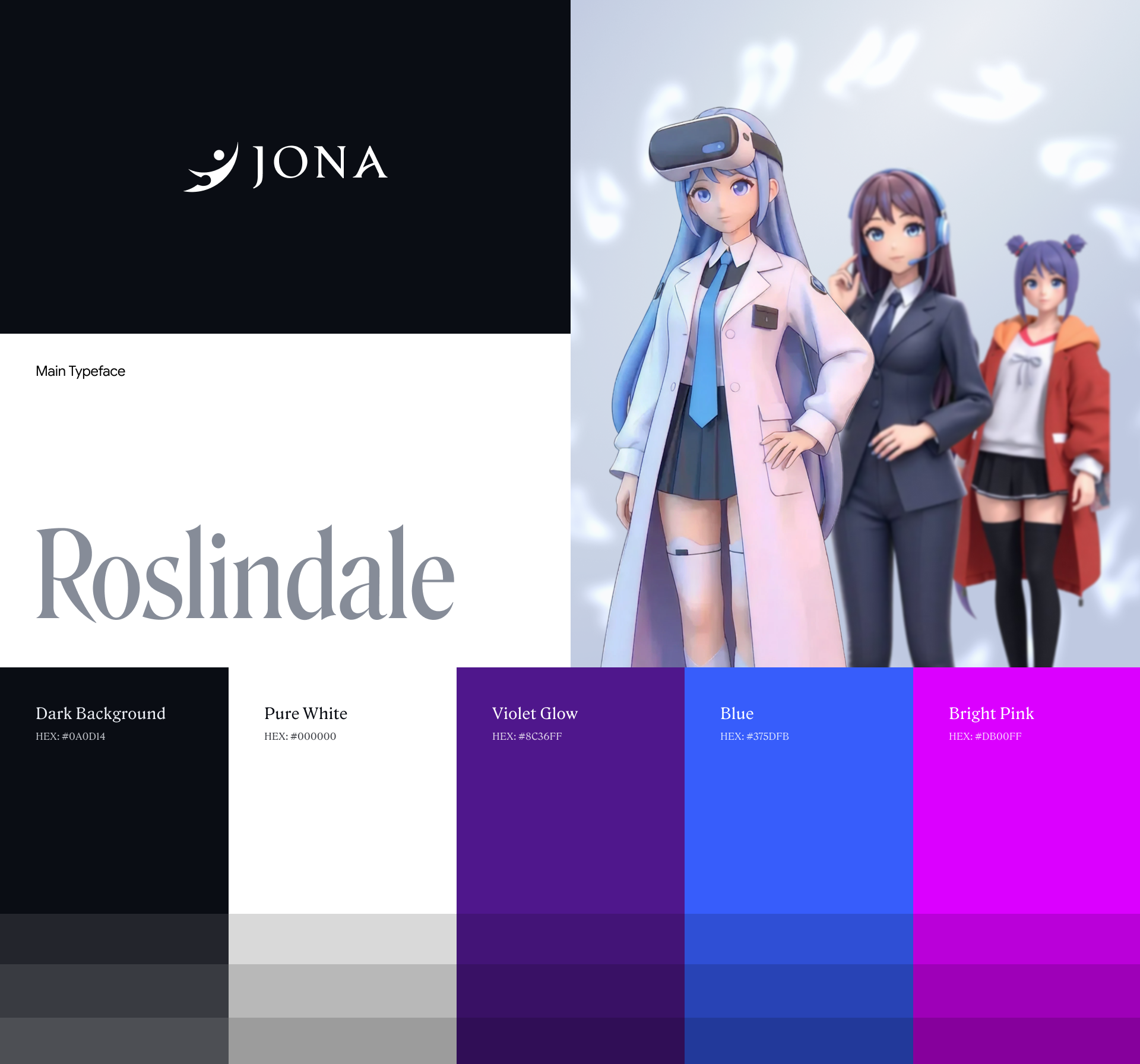
ANIME-INSPIRED AI WORKER
Instead of abstract icons or generic avatars, JONA uses stylized anime-inspired characters to represent agents.
This choice was intentional:
- Creates emotional attachment
- Gives agents identity and personality
- Differentiates from typical enterprise AI tools
The style is:
- Professional
- Non-sexualized
- Clean and consistent
It positions JONA closer to digital coworkers than chatbots.
Outcome
Delivered a complete end-to-end design for Jona’s modular AI agent platform — including core interaction models, visible intelligence growth mechanics, component library, and high-fidelity prototypes.
The design system and documentation were successfully handed off to the engineering team, enabling them to move into development. This project established a strong foundation for building customizable AI agents with clear mental models, prioritizing user agency and progressive complexity over black-box automation.
Although the product was still in early development when I left the company, the work helped validate the product direction and received positive feedback from both founders and potential users during internal reviews.
FINAL NOTE
This project reflects my core belief in product design:
– Mental models matter more than tool power
– Good systems remove decisions, not control
– The best products scale by teaching users how to think, not what to click
+84 903 308 166
CHEUNGJIAWING@GMAIL.COM
TELEGRAM_ @WINGCHEUNG0207
Get In Touch
LET’S BUILD WHAT PEOPLE LOVE TO USE.

DESIGN BY WING CHEUNG
HCMC, VIETNAM